
Disabled Valois queens

July is celebrated as Disability Pride Month, commemorating the historic signing of the Americans with Disabilities Act (ADA) on 26 July 1990.
I often reflect on how disability has been understood and perceived throughout history, and how different royal houses responded to it. In this article, I’ll explore the lives of disabled queens in the Valois dynasty who navigated the expectations, challenges, and responsibilities of royal life while living with serious disabilities.
Joan of France
Joan of Valois was one of the daughters of Louis XI and Charlotte of Savoy. Disabled from birth and raised away from court, Joan was said to have been ‘deformed and imperfect beyond what is normal with other women’. She was small in stature and hunchbacked, with one shoulder higher than the other. Her father engaged her to Louis of Orleans, the future Louis XII, hoping that the couple would not produce children. Louis resented his wife because of her disability, but she loved him.
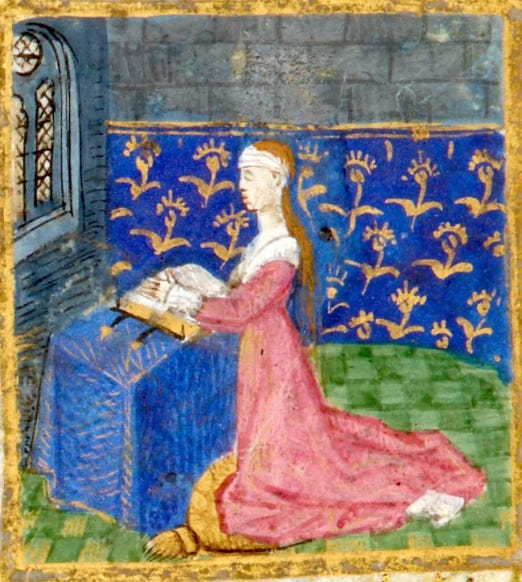
In 1498, when her brother Charles VIII died, Louis became Louis XII, and Joan became queen. Not for long, though. Louis desired to marry Charles VIII’s widow, Anne of Brittany, and sought to invalidate his marriage to Joan, but she refused to accept this.
During the trial of annulment, Louis argued that his marriage to Joan was never consummated, but Joan denied this, saying that they had sex on many occasions. She also believed herself capable of bearing children. Louis also claimed that he tried to consummate his marriage to Joan, but every time he “wanted to have intercourse with her, he found a certain twistedness at the orifice of the vulva, such that his penis could not enter”.
Joan’s marriage was eventually annulled and Louis married Anne of Brittany.
Joan’s title was demoted from Queen of France to Duchess of Berry. She retired into a religious life and was proclaimed saint in 1950.
Anne of Brittany
Anne of Brittany was a duchess of Brittany in her own right and a grand matrimonial prize. She was married by proxy to Maximilian, Holy Roman Emperor, but the marriage was never consummated and later annulled. She married Charles VIII of France and then, after his death, his successor Louis XII. Anne was thus twice queen of France.
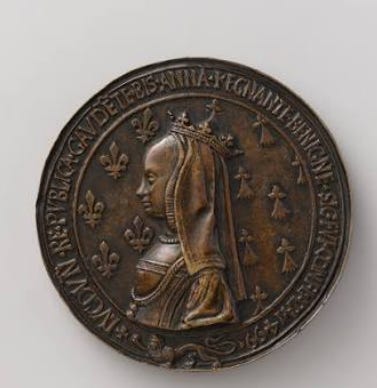
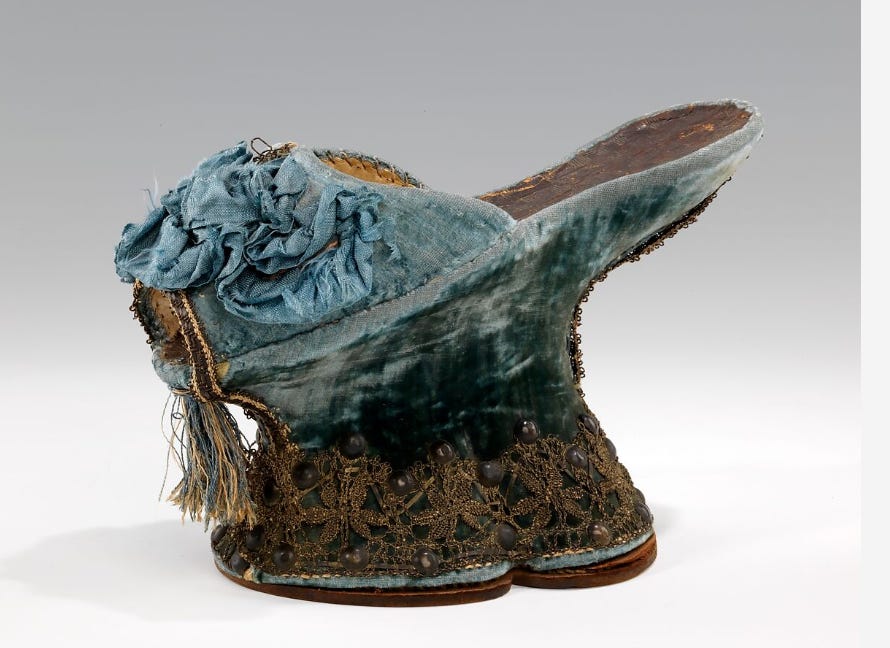
One of the Venetian ambassadors described Anne as ‘small and thin in person, visibly lame in one foot, although she uses a false heel’. He was referring to the fact that Anne used high-heeled shoes known as chopines, to help with her disability.
Pierre de Bourdeille, seigneur de Brantôme, famous French memoirist, remarked:
‘Her figure was fine and of medium height. It is true that one foot was shorter than the other the least in the world; but this was little perceived, and hardly to be noticed, so that her beauty was not spoilt by it’.
Anne died in 1514 at the age of 37.
Claude of France
During her marriage to Louis XII, Anne of Brittany gave birth to many children, but only two daughters, Claude and Renée, survived to adulthood. Because Salic Law prohibited women from inheriting the throne, neither Claude nor Renée was considered a potential successor to their father.
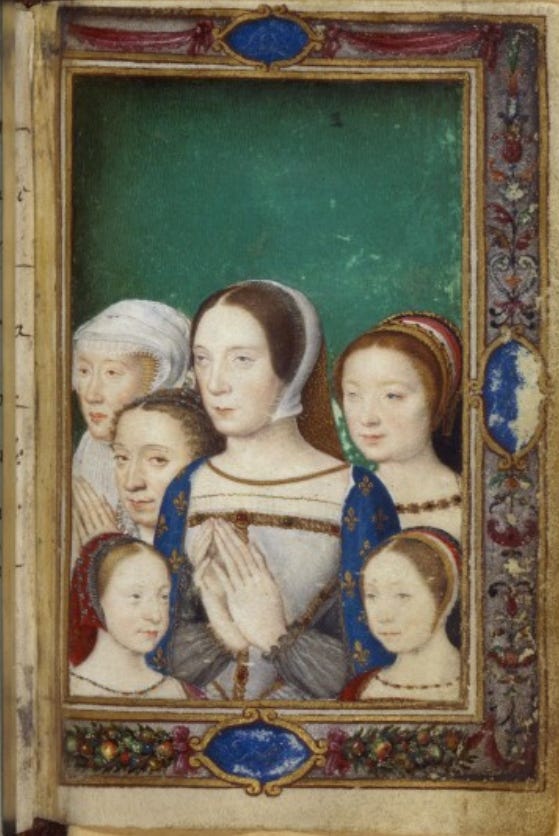
Claude, however, married Louis XII’s successor, Francis I, thus becoming queen consort of France. In 1517 she was described as “small in stature, plain and badly lame in both hips”. Pierre de Rohan, Marshal of Gié, opposed Claude’s marriage to Francis because ‘Madame Claude is deformed in body and unable to bear children’.
When Claude became pregnant for the first time at the age of fifteen, most people assumed that she would not survive the pregnancy. According to one English observer, rumour had it that even the pope alleged that “the French asserted the present Queen would die in childbed”. Claude eventually proved her critics wrong, giving birth to seven children during the period from 1515 to 1524. Historian Simone Bertière calculated that Claude was pregnant 63 of the 122 months of her reign. These frequent pregnancies took their toll on the Queen’s fragile health, and she could not attend her husband’s court and play a ceremonial role as often as etiquette required.
Claude died at the age of 24 in 1524. Some contemporaries suggested that the strain of frequent pregnancies weakened her health, while others claimed that Francis had infected her with a venereal disease.
In the next article, I’m going to take a look at the disability in the Hapsburg dynasty.
If you’re interested in learning more about the Valois queens and noblewomen of the sixteenth century, I’ve written a book about them. “Golden Age Ladies: Women Who Shaped the Courts of Henry VIII and Francis I” is now on special offer, together with two other of my e-books. Grab them while the offer lasts!

Hello Sylvia, I knew all about Claude but I didn't know about Anne of Brittany. Knew her history, not her physical disability. I did my PhD thesis on The Extra and Social Costs of Disability. My supervisor wanted much wider history as an introduction after I submitted the first completed draft and that means a huge rewrite. In 1990s there simply wasn't that much histography on this and most papers or work were at least 20 years out of date. So it was very difficult. I found some very obscure papers and the thing that surprised me most was the attitude towards disabled people. It varies very much. I had always been told the Church preaching disability and sickness is a punishment from God. This wasn't strictly true. It referred to big pandemics etc but the Church taught a variety of positive things about disabled people such as them being free from sin and being there as an example to others. They are here to encourage compassion etc
X
Social ideas were different. Social care was community and monastic based but the religious services provided care of the whole person etc but social ideas varied from fear and sin to being blessed to have disabled people around them. The strangest one was Switzerland where in some places the entire place had members of their household with large heads and deformed people called cretins. It was caused by the iron rtc in the water and environment. There people saw these people as lucky and a blessing. They want to have them as a family member. It really stood out. The Church was also saying people had to be cared for. Jobs were found for them in the monastery or the army. It was also taught that personally people sinned. It was a very weird duality. Personally people felt that it was their fault and sought forgiveness and health. It was a real mix of positive and emotional and negative reactions. There were also a remarkable range of personalised aids for disabilities etc, like the rich having clothing made to cover their inability. It's again really fascinating. People had crutches, walking sticks and even wheelchairs. Since my work a lot more has been done. Disability in Tudor English was written a few years ago and the application of carers for people who can't deal with their financial situation. There are social institutions over time, schools to teach blind people braille and other ones to help the deaf. Wheelchair development is very interesting and the fight for recognition and equality. I found the extra fuel costs are much higher
Social services and carers. The fight for proper benefits and inclusion in everything. The battles in modern times are more difficult than the attitude in the Middle Ages. It's an under studied area. There's much more available now but back in 1990s it was pioneering work.
Sylvia, I love this post! As a blind woman and disability advocate, I am especially interested in how disabled people were treated throughout history. Given the heightened visibility of a queen’s body and health, it is interesting to see how these women were viewed and how they lived their lives.