
Hiding in plain sight?
Was Anne Boleyn's miniature by John Hoskins based on a lost original?

In the seventeenth century, English miniaturist John Hoskins the Elder (c.1590–1665) created a miniature of Anne Boleyn based on the “B pattern” portrait. It was endorsed as copied “from an ancient original”, “ancient” meaning “old” in this context.[1] The golden chain on Anne’s head is not present in the NPG portrait but appears in the Hever Rose and Lyndhurst portraits of Anne.
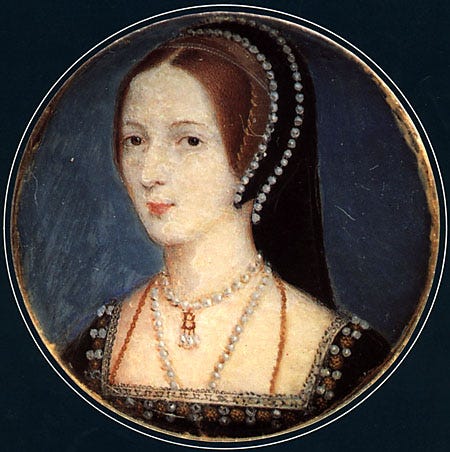
Eric Ives believed that Hoskins may have had access to an original portrait of Anne, perhaps by Holbein, and copied from it. However, if Hoskins was copying from an “ancient original”, isn’t it more likely that he copied from another miniature? The fact that Anne wears her “B” necklace points to the possibility that the original, if it was a miniature, was painted in the Horenbout workshop.
Anne and the Horenbouts
The Horenbouts, a family of Flemish painters, came to England in the 1520s to work at the court of Henry VIII. By that time Gerard was already established as a skilled artist. He worked for Archduchess Margaret of Austria, one of the greatest sixteenth-century patronesses of art, before relocating to England. Lucas, Gerard’s son, was first recorded as painter at Henry VIII’s court in September 1525. Susanna, Gerard’s daughter, worked as a miniaturist, painter and manuscript illuminator.
During their courtship, Henry and Anne exchanged love letters written in French and in English. In one of the letters, the king mentions a gift: “my picture set in a bracelet.” It was certainly a miniature and the only workshop producing miniatures at this time in England was the Horenbout workshop.
Anne used her surname, Boleyn, until 1529. In 1529 Anne’s father received a double earldom of Wiltshire and Ormond, and Anne and her siblings adopted “Rochford” as their surname. Then, in 1532, Anne became a Marchioness of Pembroke, and was referred to as “Anne Pembroke”.
If Hoskins’s miniature was based on a lost original, then that original can be dated to the period before 1529, when Anne used her Boleyn surname.
According to Ives, the Hoskins’ miniature “is important because it preserves what a highly talented seventeenth-century miniaturist made of the [original] image, and though again further softened, it is the best depiction of Anne we are likely ever to have, failing the discovery of new material”.[2]
Is the real Anne hiding in plain sight, then? Is Hoskins’s miniature “the best depiction of Anne we are likely ever to have”? I still hope a contemporary portrait or miniature survives somewhere, waiting to be discovered.
—
If you like my posts, you’ll love my books! Secrets of the Tudor portraits is out now, you can also read my other books.
[1] Eric Ives, The Life and Death of Anne Boleyn, p. 43.
[2] Ibid.
I bet she's indeed hiding right there.that would be so amazing- having a real.likeness of Anne. Of course, we have the most famous portrait, the Rose portrait, but something in it seems odd. This one actually could explain what Henry saw when he laid eyes on Anne. I like her expression, too- that sense of irony that is right there in her smile. She's so alive- and she deserves that, to have an adequate depiction.
It might just be me, but I think this portrait looks much more human than some of the others of her.